Using Seasonality to Spot Fraud, Waste, and Abuse Red Flags in Claims Data

Using Seasonality to Spot Fraud, Waste, and Abuse Red Flags in Claims Data
School's out. Flu season is behind us. Summer is in full swing. But if your claims data is telling the exact same story it did in January... it may be time to ask why.
Healthcare utilization naturally changes throughout the year. School schedules, seasonal illnesses, travel, weather, and patient behavior all influence when and how services are delivered. For Special Investigation Units (SIUs), those predictable shifts create an opportunity to identify billing patterns that simply don't fit.
Let's be clear, seasonality is not proof of fraud, waste, or abuse (FWA). But it is a valuable tool for asking smarter questions, uncovering unusual billing patterns earlier, and focusing investigative efforts where they matter most.
Sometimes summer claims look exactly as expected... and sometimes they don't.
Why Seasonality Matters More Than You Think
Every investigator is looking for the same thing: patterns that deserve a second look.
Seasonal trends provide a baseline for distinguishing normal activity from billing behavior that warrants review. Rather than investigating every increase or decrease, investigators should use that baseline to determine when activity falls outside expected patterns.
A good starting point is comparing current summer usage against historical trends, adjacent months, peer providers, regional benchmarks, member age groups, and known benefit or network changes.
Once an outlier appears, the next question becomes: What’s driving it?
Is the trend concentrated within one specialty? One provider group? A specific diagnosis category or place of service (POS)? Is utilization increasing across the entire population or only among a handful of billing entities?
Those are the questions that help move an investigation forward.
💡 Often, the most meaningful insights aren't hidden in a single claim. They're found in utilization patterns that emerge over time.
So, what does "normal" actually look like during the summer months?
Expected seasonal patterns provide valuable context for interpreting billing activity and identifying meaningful deviations.
Understanding Expected Summer Claims Patterns
Summer brings predictable shifts in healthcare activity. Those expected changes help investigators place unusual billing behavior in the proper context.
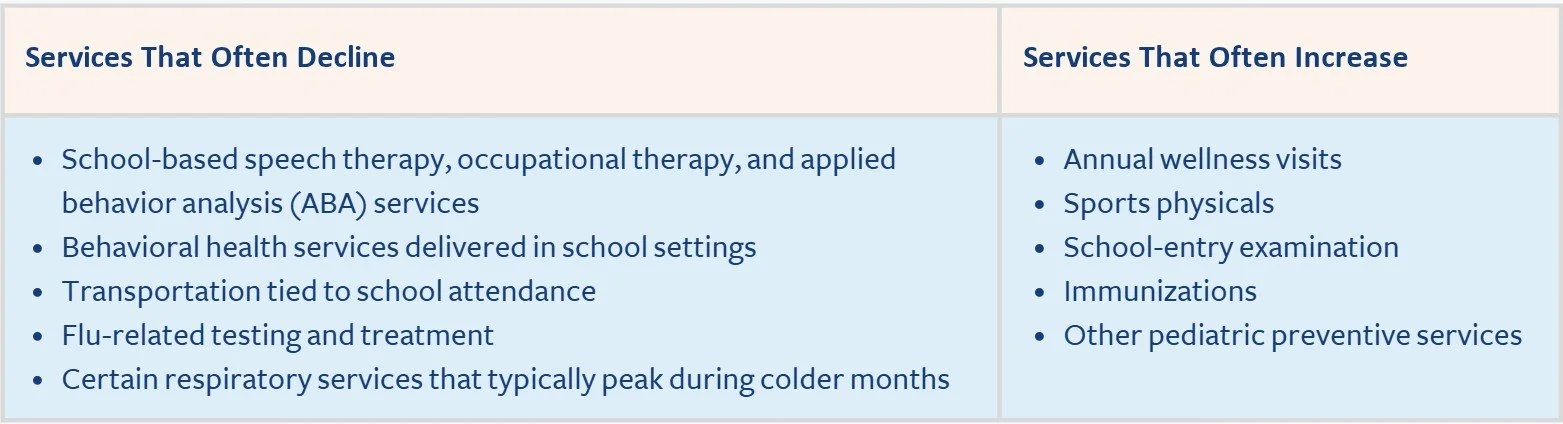
⬇️ Services that typically decline during the summer don't always indicate a problem when they remain steady. Before escalating concerns, consider legitimate explanations such as extended school year programs, summer camps, year-round school calendars, or localized disease activity.
⬆️ Increased claims activity isn't automatically a red flag either. Membership growth, network expansion, benefit changes, and new provider contracts can all contribute to higher claims volume. Comparing those trends to peer providers and historical patterns helps determine whether growth is expected or warrants further analysis.
Even expected seasonal increases can create opportunities for FWA. During busy back-to-school periods, investigators may want to watch for unbundling annual wellness visits from evaluation and management (E&M) services that are not separately identifiable, or for upcoding E&M visits.
💡 Keep in mind... the increase itself is not the concern. The billing behavior within that increase might be.
Summer Red Flags That Deserve a Second Look
It's important to look beyond the big picture and identify patterns that may suggest additional review. Some summer red flags include:
Significant spikes in school-based claims when schools are not in session
High-volume flu or respiratory testing outside typical respiratory seasons
Repeated respiratory testing for the same member within a short timeframe
Providers whose utilization diverges sharply from peer benchmarks
Repeated billing activity on weekends, holidays, or other unusual service dates
Sudden changes in place-of-service patterns
Unbundling, duplicate billing, or separately billed services that would not normally be expected
💡 These indicators are conversation starters, not conclusions.
They help investigators determine where additional data analysis, documentation review, provider outreach, or operational insight may be appropriate.
Codes Behind the Clues
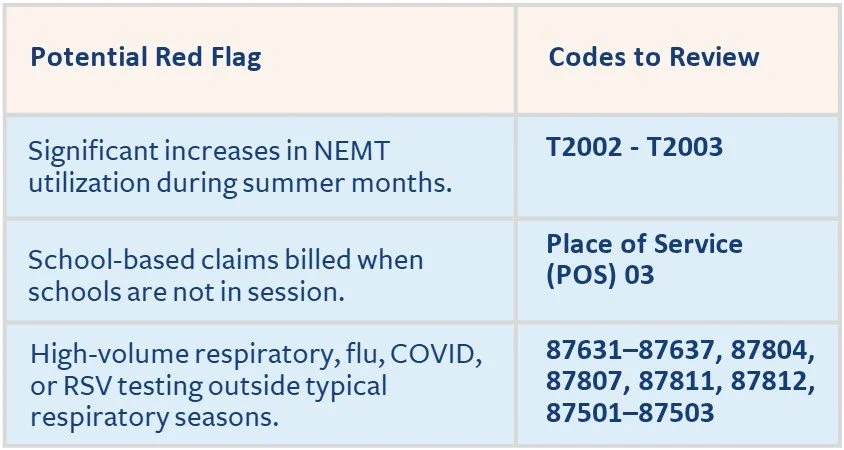
Sometimes the biggest clues are hiding in the codes.
When codes are reviewed alongside seasonal trends, they shed light on what's driving an unusual billing pattern. While no individual code proves FWA, it can help determine whether additional analysis is justified.
💡 The codes aren't the story. The patterns within them are.
Making Seasonality Part of Everyday Surveillance
Understanding seasonal trends is most effective when seasonality is built into your everyday investigative strategy. Here are a few ways to incorporate it into your existing SIU workflow:
➡️️ Incorporate seasonal reviews into routine monitoring. Rather than treating seasonality as a one-time analysis, schedule regular reviews throughout the year. This can help your team recognize unusual activity faster.
➡️️ Bring multiple data sources together. Combining claims analytics with provider enrollment information, peer comparisons, school calendars, public health surveillance data, referral patterns, and medical records provides a more complete picture of what's driving suspicious activity.
➡️ Take advantage of the tools you already have. For Medicare Advantage, Part D, and Medicaid managed care organizations, quarterly utilization reports available through the HPMS portal can provide another layer of oversight. Used alongside your existing analytics, they can help prioritize investigative efforts and identify emerging trends.
💡 Seasonality delivers the greatest value when it's built into everyday SIU operations.
Turning Summer Trends into Smarter Investigations
Every season tells a story... and your claims data should too.
Summer brings predictable changes in healthcare activity, creating opportunities to uncover patterns that might otherwise go unnoticed. When seasonality becomes part of routine surveillance, teams can identify unusual billing activity sooner, ask better questions, and make more informed investigative decisions.
💡 The sooner you recognize what's expected... the sooner you'll recognize what isn't.
Integrity Advantage is Here to Help
Whether it’s conducting FWA program assessments, strengthening internal processes, or providing outsourced SIU support, Integrity Advantage partners with healthcare organizations nationwide to turn insights into action. Together, we help teams achieve measurable progress. Integrity Advantage is a certified Women’s Business Enterprise (WBE) and Woman Owned Small Business (WOSB).
With more than 30 years of experience supporting payers, the team at Integrity Advantage provides healthcare fraud, waste and abuse consulting, outsourced investigations and medical record reviews for Special Investigations Units and other organizations fighting healthcare fraud. We are a certified Women’s Business Enterprise (WBE) and an Economically Disadvantaged Woman Owned Small Business (EDWOSB).
For more information click below, call us at 866-644-7799 or email info@integrityadvantage.com.